The United States has launched fresh strikes on Iran, citing the need to protect shipping routes through the strategic Strait of Hormuz, while Tehran responded with attacks on Kuwait and Bahrain. The latest exchange of military action has further complicated diplomatic efforts aimed at halting the conflict and raised concerns over wider instability across the Middle East.
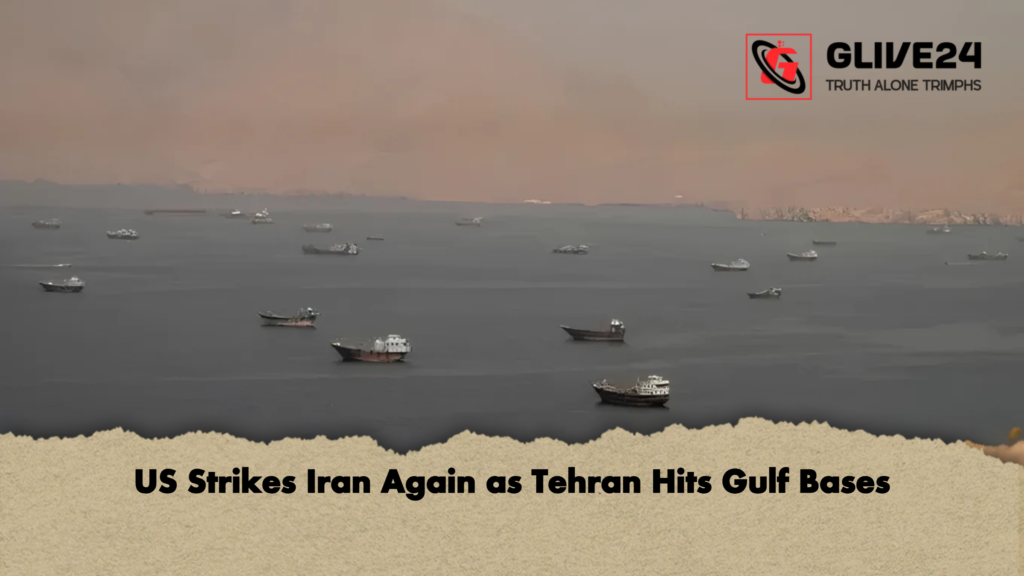
The US military confirmed on Wednesday that the operation was carried out in response to attacks on three commercial vessels travelling through the Strait of Hormuz a day earlier. The strikes came just hours after US President Donald Trump said he believed the temporary ceasefire arrangement with Iran had effectively come to an end.
The United States Central Command (CENTCOM) said the new military action was intended to reduce what it described as threats posed by Iran to maritime security in the vital waterway. The command accused Tehran of being responsible for recent attacks targeting commercial ships and civilian sailors using the international shipping route.
Following the US strikes, panic spread across several areas along Iran’s southern coastline. Local reports said electricity supplies were disrupted in some locations, while security was tightened around key strategic facilities.
Iran responded by launching attacks on Kuwait and Bahrain for the second consecutive day. Both countries host important US military installations, making them significant targets during rising regional tensions.
Kuwait’s Defence Ministry said its forces were intercepting Iranian missiles and drones. Qatar also briefly raised its security alert level before later withdrawing the measure. A US official, speaking on condition of anonymity, said the scale of Wednesday’s US strikes against Iran would be greater than those carried out the previous day.
US President Donald Trump later wrote on his social media platform that the operation was a response to Iran’s earlier attack on ships. He warned that Washington would deliver a stronger response if similar incidents occurred in the future.
The Strait of Hormuz remains one of the world’s most important energy corridors. Before the latest conflict began, around 20 per cent of global oil supplies passed through the narrow waterway. Iran’s geographical position and influence over the strait give it a major strategic role in international energy markets.
Although Iran has not officially accepted responsibility for the attacks on commercial vessels, some analysts believe Tehran may have used the situation to strengthen its position in negotiations. Iran’s chief negotiator Mohammad Bagher Ghalibaf said on social media that the United States should not expect to avoid consequences after making threats and breaking commitments. He warned that Iran would respond to any military action and insisted that shipping through the Strait of Hormuz would only return to normal under arrangements determined by Iran, not through American pressure.
The latest escalation has also reduced hopes that the memorandum of understanding signed on 17 June could eventually develop into a permanent peace agreement. Before travelling to a NATO summit in Türkiye on Wednesday, Trump told reporters that the agreement appeared to be “over” and said he no longer wished to negotiate with Iran.
Later, Trump said he was uncertain whether any future agreement with Tehran would remain effective, arguing that he did not trust Iran. However, he also stated that he did not expect a full-scale war to resume and claimed the situation could be resolved quickly, with global supply chains, including energy markets, becoming more secure.
The renewed conflict has already affected international oil prices. By 12:54 am Greenwich Mean Time on Wednesday, Brent crude prices had risen by around 1 per cent to $78.80 per barrel. However, prices remain significantly below the level of more than $120 per barrel recorded at the end of April.
Iranian media reported that the latest US strikes focused mainly on the country’s southern coastal regions, stretching from the Strait of Hormuz towards the Gulf of Oman. Areas reportedly affected included Bandar Abbas, Iran’s largest port city, which hosts a major naval base and facilities linked to the Islamic Revolutionary Guard Corps.
Other targeted areas reportedly included the coastal cities of Konarak and Chabahar near the Pakistan border. Reports said electricity was temporarily cut in parts of Chabahar but was later restored in most areas. There were also reports of damage to maritime traffic control facilities.
Iranian state media reported that a firefighter was killed in a strike on an airport in the south-eastern city of Iranshahr. Meanwhile, Iranian state television reported that a railway bridge near Aq Qala in northern Iran was also targeted.
Before the US operation, Iranian Foreign Ministry spokesman Esmail Baghaei accused Washington of violating the memorandum of understanding between the two countries. He claimed that under the agreement, Iran was responsible for ensuring safe navigation through the Strait of Hormuz.
A representative of Iran’s parliamentary National Security Commission said Tehran could consider withdrawing from the Nuclear Non-Proliferation Treaty (NPT) in response to the situation. He also suggested that Iran might review its nuclear policy and consider closing the Bab al-Mandab Strait, another crucial maritime route connecting the Red Sea with the Gulf of Aden.
The Iranian mission to the United Nations submitted a letter to the UN Security Council on Wednesday, accusing the United States of violating the UN Charter, international law and the bilateral agreement between the two countries.
The latest confrontation has intensified fears that a localised dispute could develop into a broader regional crisis. With key shipping routes, energy supplies and military assets involved, international observers are closely monitoring whether diplomatic channels can prevent further escalation.