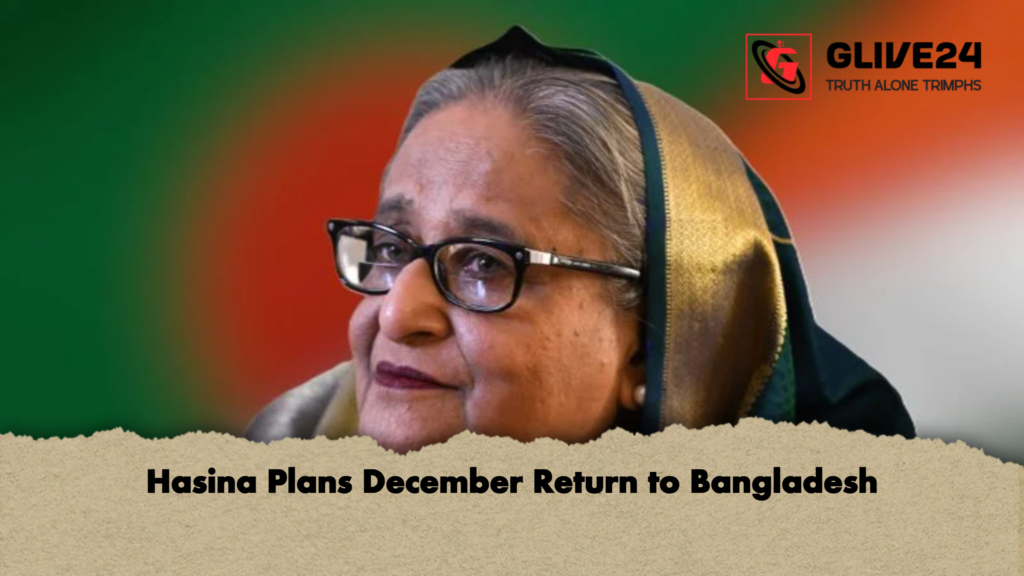
Former Bangladeshi Prime Minister Sheikh Hasina has said she intends to return to Bangladesh from India in December and surrender before the country’s courts, according to remarks she made in a telephone interview with Reuters. She also claimed that several senior leaders of her political party had decided to return alongside her.
The interview, conducted on Thursday night and reported by Reuters on Friday, marks the first time since leaving Bangladesh that Hasina has publicly identified a specific timeframe for a possible return. In her remarks, she acknowledged that she could face arrest upon arrival and expressed concern about her personal safety. Despite those risks, she said she wished to return to her homeland.
Hasina argued that members and supporters of the Awami League were facing persecution and maintained that, if she were ultimately to meet her fate, she would prefer it to happen in Bangladesh rather than abroad. She said she and several senior colleagues had chosen voluntarily to face the country’s judicial process, adding that their surrender would, in her view, demonstrate whether the courts and state institutions conduct proceedings in an impartial manner.
Bangladesh’s political landscape underwent a dramatic transformation following the mass uprising of July and August 2024, which led to the removal of Hasina’s government from office. She subsequently travelled to India, where she has remained since leaving Bangladesh.
The source material states that judicial proceedings were later initiated against Hasina over allegations of crimes against humanity and that an international tribunal handed down a death sentence in November. It also says that the political activities of the Awami League and its affiliated organisations were subsequently banned. These developments have become central issues in Bangladesh’s continuing political and legal debate.
The Bangladeshi government has previously sought Hasina’s extradition from India, making the matter an important point of discussion in bilateral diplomatic relations. In her interview, however, Hasina said she had not consulted any foreign government regarding her decision to return. She also claimed that, although pressure was being placed on India to hand her over, her planned return was entirely her own decision rather than the result of external negotiations.
Her announcement is likely to attract considerable attention because it introduces a concrete timeline after many months of speculation about her future. Whether such a return ultimately takes place will depend on a range of factors, including legal procedures, security considerations and decisions by the relevant authorities.
Among senior Awami League figures, former Home Minister Asaduzzaman Khan Kamal was also identified in the source material as being among those facing the same case. However, no official public statement has been issued by him or other senior party leaders confirming that they intend to return to Bangladesh alongside Hasina. Reuters reported that attempts to obtain comments from other Awami League leaders were unsuccessful.
Reuters also said it sought responses from representatives of the Bangladeshi government regarding Hasina’s remarks. According to the report, no official response had been received by the time the article was published.
Political observers believe that Hasina’s stated intention to return could reignite political debate at a time when Bangladesh continues to navigate the consequences of prolonged political upheaval. Whether her planned surrender materialises, and how any subsequent legal proceedings unfold, will depend on decisions taken by the competent authorities, prevailing security conditions and the wider political environment.