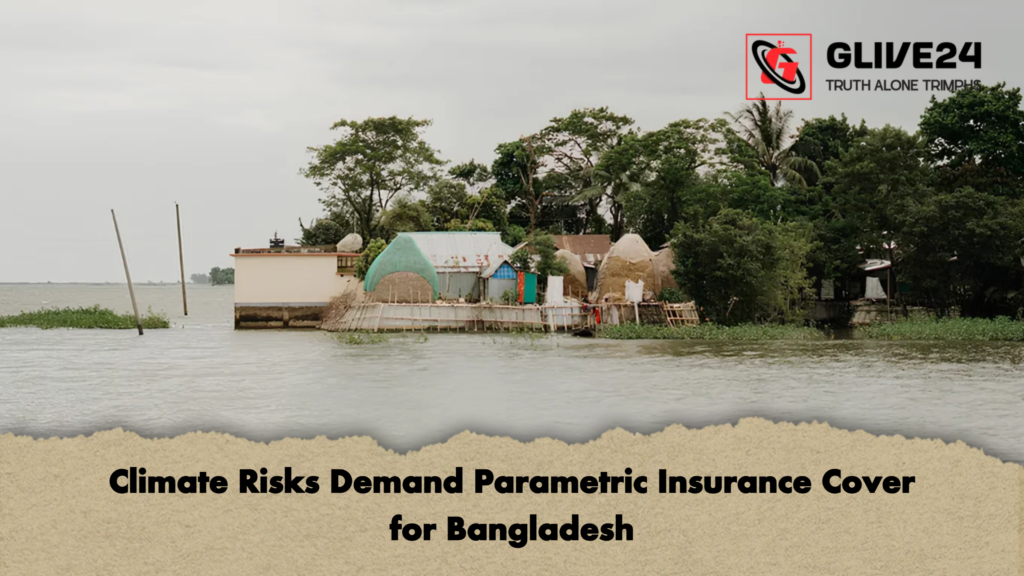
In Bangladesh, flooding has evolved from a seasonal natural disaster into a catastrophic financial crisis for millions. Rising river waters routinely submerge homesteads, while riverbank erosion permanently swallows entire villages. The immediate aftermath is devastating: decimated crops, lost livestock, and shattered micro-businesses. However, the most daunting question arises after the deluge recedes: how do families rebuild from scratch?
The financial trauma of flooding extends far beyond temporary displacement. It erodes years of hard-earned family savings, liquidates assets, and derails future generations. Despite Bangladesh being at the epicentre of climate vulnerability, formal insurance protection remains woefully inadequate. Consequently, affected communities are trapped in a cycle of dependency, relying heavily on discretionary relief, high-interest loans, or marginal assistance from relatives. Disaster management experts argue that traditional aid and ad-hoc rehabilitation programmes are no longer sufficient. There is an urgent need for institutionalised financial safety nets that empower vulnerable populations to recover with dignity.
Persistent Inundation Across High-Risk Districts
The lives of communities dwelling along Bangladesh’s vast river networks are perpetually tethered to hydrometeorological risks. Regions such as Kurigram, Gaibandha, Lalmonirhat, Jamalpur, Sirajganj, and Sunamganj face severe disruptions almost every year. The 2026 monsoon season has introduced fresh anxieties. Data from the Flood Forecasting and Warning Centre (FFWC) of the Bangladesh Water Development Board indicates critical water levels across major river basins. Short-term inundations threaten low-lying sectors within Bandarban, Cox’s Abbey, Feni, Chittagong, and Khagrachhari.
Simultaneously, water levels of northern rivers, including the Brahmaputra, Dharla, and Dudhkumar, are under constant surveillance. For residents of the remote char islands in Kurigram, the threat of submergence is a reality that endangers their homes, livestock, and primary agricultural assets. Without structured financial safety nets, the process of recovery becomes excessively prolonged and economically draining.
Economic Aftershocks: Obliterated Assets and Uncertain Livelihoods
The financial blow of flooding falls disproportionately on low-income groups whose entire net worth typically comprises a modest mud house, a small patch of arable land, a few head of cattle, or a small bazaar shop. For a marginal farmer, a flood does not merely mean losing the current harvest; it signifies the loss of capital required to buy seeds, fertilisers, and fuel for the subsequent planting cycle. For day labourers, inundation cuts off employment options for weeks, forcing them into destitution.
The situation is uniquely harrowing for victims of riverbank erosion. When floodwaters eventually recede, many find that their homesteads have completely disappeared into the riverbed. This permanent loss of land triggers long-term displacement, driving rural families into urban slums where they face structural poverty.
The Insurance Deficit in Climate Adaptation
Despite Bangladesh’s high exposure to extreme weather events, the domestic insurance sector remains underdeveloped. The overall insurance penetration rate sits below one per cent of the national Gross Domestic Product (GDP). This implies that the vast majority of citizens operate entirely outside the formal financial safety net.
Several structural factors contribute to this protection gap. Public awareness regarding insurance products is minimal, and traditional distribution models rarely reach remote rural communities. Crucially, low-income households struggle to afford conventional premium structures, and insurers hesitate to cover high-risk catastrophic events. As a result, those who face the greatest climatic hazards are left with the least financial defence. To survive the aftermath of a disaster, families frequently resort to high-interest informal loans or the distress sale of remaining assets.
Institutional Reforms in Crop and Property Coverage
While micro-insurance initiatives and agricultural cover exist conceptually within Bangladesh, they have failed to scale effectively. During major crises, citizens require affordable, low-premium insurance policies that guarantee rapid payouts without complex bureaucratic delays.
Sector specialists suggest that climate risk frameworks must be explicitly synchronised with the socio-economic realities of smallholders, fishermen, and rural entrepreneurs. Streamlining the claims settlement process is critical; if compensation arrives months after the event, its utility in preventing severe poverty is vastly diminished.
Lessons from the 2024 Inundation and Future Projections
The catastrophic floods of 2024 served as a grim reminder of Bangladesh’s extreme vulnerability. A sudden deluge swept across eleven eastern districts, affecting nearly 5.7 million people. Zones like Feni, Cumilla, Noakhali, Lakshmipur, Brahmanbaria, Chattogram, and Khagrachhari witnessed unprecedented infrastructure damage and humanitarian distress.
Entire communities lost their agricultural yields and aquaculture projects overnight, plunging them into severe debt cycles. The scale of the 2024 crisis demonstrated that relying solely on post-disaster charity cannot ensure sustainable economic recovery. A proactive, pre-funded risk management strategy is essential to insulate vulnerable households from total financial collapse.
Furthermore, climate change is altering regional weather patterns, making events less predictable. Excessive rainfall, sudden upstream water releases, river sedimentation, and rising sea levels mean that floods are becoming more erratic and destructive. Consequently, structural interventions like embankments must be complemented by modern financial risk transfer mechanisms.
Parametric Insurance as a Sustainable Solution
To address these escalating challenges, Bangladesh can look toward innovative index-based financial instruments, specifically parametric insurance. Unlike traditional indemnity insurance, which requires lengthy, on-site loss assessments, parametric policies trigger automatic payouts based on pre-defined environmental indexes.
For instance, if rainfall volume, wind speed, or river height readings cross an agreed threshold at specific monitoring stations, the policy pays out immediately. This mechanism bypasses complex claims verification processes, injecting liquidity into the affected community within days of the disaster occurring. For smallholders and market vendors, this rapid cash flow can mean the difference between immediate recovery and long-term financial ruin.
Ultimately, mitigating climate-induced economic shock requires a coordinated partnership between the state, private insurers, international development organizations, and microfinance institutions. While humanitarian aid is vital during an active crisis, long-term economic resilience depends on embedding insurance into the national disaster management framework. Floodwaters eventually recede, but the journey out of debt and displacement takes years. Integrating structured climate insurance can provide the necessary foundation for vulnerable communities to rebuild their lives securely.