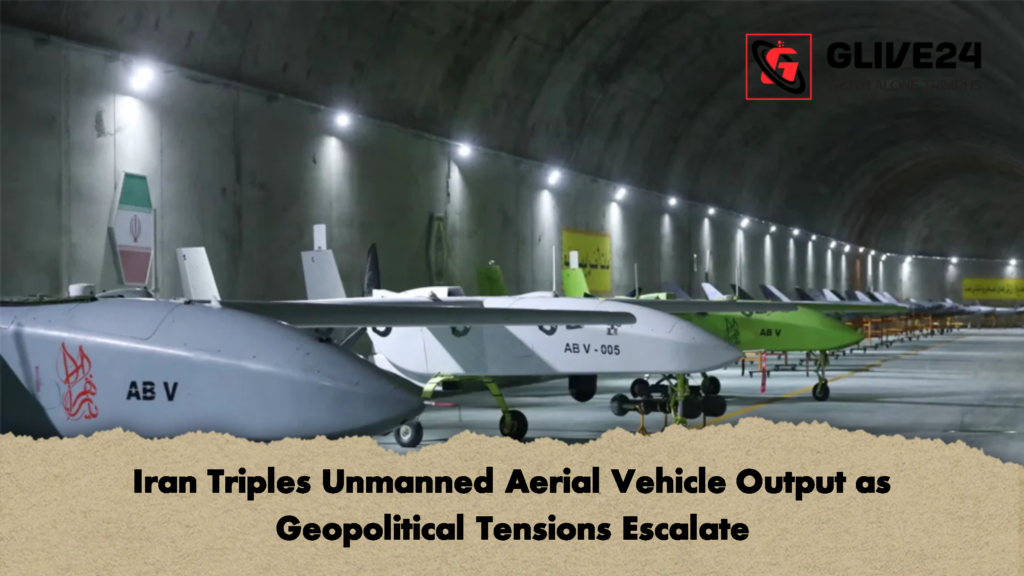
Tehran’s defense establishment has significantly accelerated its military-industrial output, officially confirming that its domestic drone manufacturing capacity has expanded threefold. The revelation was made public by Iran’s Acting Defence Minister, Majid Ibn Al-Reza, via the state-affiliated Tasnim News Agency. This drastic industrial expansion comes at a time of severe international friction, drawing intense scrutiny from Western defense ministries and global security monitors who track the proliferation of uncrewed systems.
The massive production surge underscores how heavily the nation relies on asymmetrical warfare strategies to bypass conventional military limitations. In his address, the acting defence minister asserted that contemporary combat environments have validated Iran’s long-term reliance on local engineering talent and targeted funding for advanced technologies. According to Ibn Al-Reza, the country’s weapons assembly lines suffered zero downtime or supply chain disruptions, even during periods of intense regional volatility. Instead, defense factories successfully reallocated capital and raw materials to triple the net production volume of their uncrewed aerial vehicle (UAV) programmes.
“Recent history has demonstrated that our human capital and home-grown high-tech research are the most vital pillars of our sovereign defense capability,” stated Acting Defence Minister Majid Ibn Al-Reza. “Production did not falter during peak operational strains; rather, it multiplied.”
The Architecture of a Sanction-Proof Supply Chain
Tehran attributes this manufacturing spike to decades of pre-war infrastructure spending, domestic engineering research, and specialized technical institutes. Faced with strict international trade embargoes and a highly restrictive Western technology blockade, the state systematically pivoted toward complete self-reliance. Rather than depending on imported electronics or foreign aviation components, the state’s military-industrial complex focused on:
-
Reverse-Engineering Protocols: Deconstructing downed foreign reconnaissance platforms to replicate advanced navigation systems.
-
Academic Pipelines: Funneling top engineering graduates from domestic universities straight into military research laboratories.
-
Commercial Component Integration: Adapting easily obtainable, dual-use civilian microchips and engines for military aviation.
Strategic analysts observe that this industrial output carries deep implications for global defense networks. Iranian-designed loitering munitions—frequently referred to as “suicide drones”—along with long-range reconnaissance aircraft have evolved into staple weapons in modern friction points. Western intelligence agencies have repeatedly flagged the deployment of these low-cost, high-impact platforms across multiple active battlefields, spanning both sub-state proxy factions within the Middle East and large-scale conventional deployments in Eastern Europe.
While Iranian officials reiterate that their military growth remains purely defensive and intended to deter foreign intervention, the sheer scale of a threefold manufacturing increase points to an export-ready wartime economy. The production lines favor highly cost-effective, easily mass-produced models engineered to overwhelm advanced air defense batteries through sheer numbers and saturation tactics. By merging domestic factory floors with academic research pipelines, the Iranian government has transformed its state-sanctioned drone programme into a powerful tool of geopolitical leverage, ensuring a continuous flow of hardware despite intense diplomatic and economic pressure.