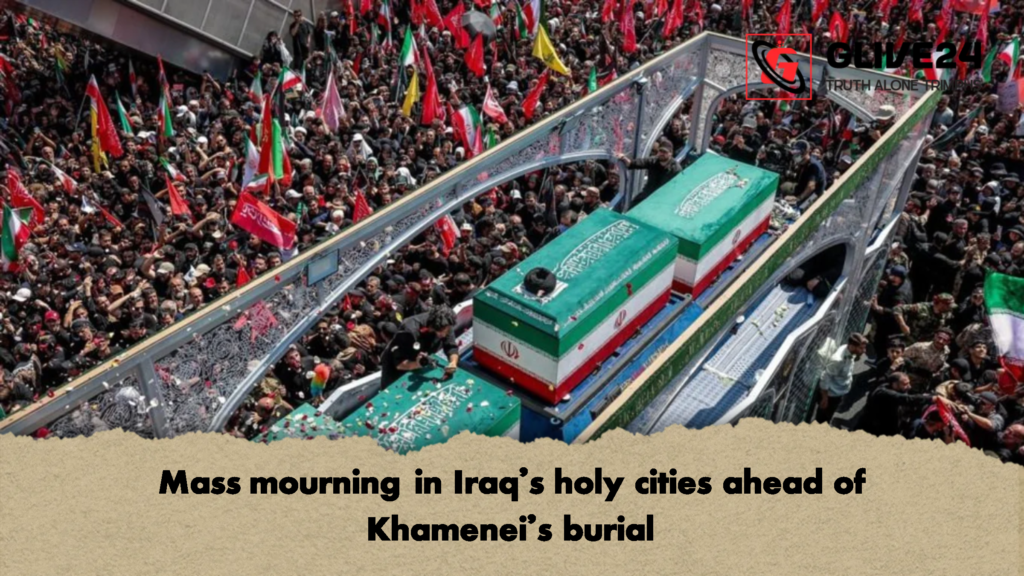
Vast crowds of Shia mourners have gathered in the Iraqi holy cities of Najaf and Karbala to pay their final respects to Iran’s Supreme Leader, Ayatollah Seyyed Ali Khamenei. The high-profile processions marked the conclusion of regional mourning ceremonies before the leader’s body was flown back to Iran for interment.
According to official state claims released by Iranian authorities, the 86-year-old Supreme Leader was killed in late February during a targeted US-Israeli air strike on his official residential compound in Tehran. Following months of political transition, security restructuring, and extensive public memorials, his final burial is scheduled to take place tomorrow, Thursday 9 July, in the northeastern Iranian city of Mashhad.
Processions traverse symbolic Shia heartlands
The symbolic journey through Iraq highlighted the deep trans-national religious links binding the Shia populations of Iran and Iraq. In Najaf, home to the sacred shrine of Imam Ali, thousands of people lined the streets, chanting traditional religious elegies and lifting portraits of the late Supreme Leader. Senior Iraqi clerics, political figures, and representatives from regional partners joined the local populace to perform funeral prayers.
The procession subsequently moved to Karbala, the spiritual epicentre of Shia Islam. Mourners packed the sprawling plazas situated between the historical shrines of Imam Hussein and Hazrat Abbas. Security was exceptionally tight across both governorates, with joint Iraqi security forces and local popular mobilisation units cordoning off entire sectors to protect foreign dignitaries and religious scholars in attendance.
Repatriation and final logistics in Mashhad
Following the conclusion of the Iraqi ceremonies, a special transport aircraft repatriated Ayatollah Khamenei’s casket to Iran, landing at a heavily fortified military airfield. From there, the body is being transferred to Mashhad, the late leader’s birthplace and home to the Imam Reza shrine—one of the most significant spiritual sites in the Islamic world.
Vast public funeral processions are held across the Iraqi holy cities of Najaf and Karbala, drawing thousands of regional mourners.
A special aircraft returns Ayatollah Khamenei’s casket to Iran, landing at a secure military airfield before transfer to Mashhad.
The final state interment service is scheduled to take place within the central district of the holy Imam Reza shrine.
Preparing for millions of pilgrims
Local authorities in Mashhad have finalized expansive logistical arrangements to accommodate the millions of pilgrims and state officials expected to flood the city for Thursday’s interment. Municipal services have made public transport entirely free, temporary medical camps have been set up throughout the urban grid, and strict security cordons have been established around the central shrine district to manage the massive crowds safely.
The burial brings an end to a prolonged period of intense national uncertainty following the unprecedented assassination in late February. The strike on the high-security compound in Tehran sent shockwaves through the global geopolitical landscape, triggering severe diplomatic crises and military standoffs across the Middle East. With the final funeral rites concluding this week, Iran enters a definitive new chapter as its institutional leadership solidifies the state’s political transition.