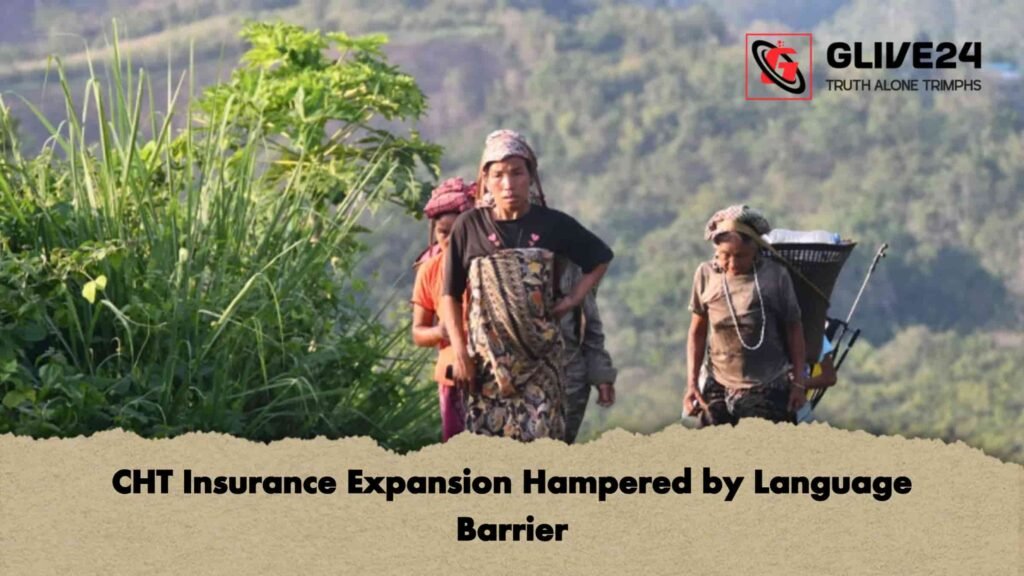
The penetration rate of the insurance sector across Bangladesh remains notably low, fluctuating between just 0.33% and 0.5% of Gross Domestic Product (GDP). This baseline sits substantially beneath the global average. However, the deficit is at its most acute within the Chittagong Hill Tracts (CHT)—specifically across the districts of Rangamati, Khagrachhari, and Bandarban—where insurance services remain exceptionally limited. Industry analysts and stakeholders state that profound linguistic barriers, a deficit in public awareness, weak field-level corporate operations, and a historic crisis of trust leave the majority of the hill population completely missing from financial protection.
Linguistic Disconnect and Geographic Isolation
Experts tracking the CHT finance sector assert that language is the single greatest operational challenge to commercial expansion. The formal institutional and technical terminology utilized inside standard insurance policies is highly complex. For an ordinary citizen, vocabulary such as surrender value, lapsed policy, and surrender of bonus is difficult to grasp.
This conceptual difficulty is magnified for the indigenous communities of the region—such as the Chakma, Marma, Tripura, and Mro—who speak their own distinct native languages. When these complex Bengali financial terms are introduced, they appear entirely alien to local residents, causing many to lose interest at the introductory stage.
Geographical realities complicate field-level logistics even further:
-
Terrain Inaccessibility: Numerous remote villages are located deep within mountainous areas, separated by vast physical distances.
-
Communication Friction: Fieldworkers find it logistically difficult to maintain consistent contact with clients.
-
Cultural Gap: The vast majority of insurance agents are recruited from the plains and possess little to no understanding of local dialects or cultural norms, making the construction of meaningful client relationships nearly impossible.
Performance Statistics and the Deficit of Trust
A wider national backlog in claims settlement heavily damages institutional credibility within the hill tracts. A widespread perception persists among local communities that even after regular premium payments are completed, collecting the final payout is a complicated process.
This public skepticism is supported by recent documentation from the Insurance Development and Regulatory Authority (IDRA). National performance data from January to September 2025 shows that while domestic insurance firms collected Tk 4,600 crore in premiums, they settled only Tk 2,221 crore in claims—amounting to roughly 48% of total premium income. Concurrently, outstanding unpaid claims across the sector reached a staggering Tk 9,624 crore.
National Insurance Claims Performance (Jan–Sep 2025)
| Insurance Sector | Premiums Collected (Tk) | Claims Settled (Tk) | Specific Settlement Rate |
| Life Insurance | 3,050 crore | 2,106 crore | 35.18% |
| Non-Life Insurance | 1,547 crore | 275 crore | 7.55% |
| Industry Aggregate | 4,600 crore | 2,221 crore | 23.00% (Average) |
Note on Industry Performance: During this measured nine-month window, the average claims settlement rate across the entire insurance sector stood at just 23%, a metric heavily influenced by the low 7.55% payout rate in non-life insurance.
Local policyholders report that while sales representatives describe policy benefits in highly accessible terms during initial marketing pitches, the maturity or claims phase introduces dense documentation, rigid terms, and extensive bureaucratic delays. This mismatch has generated long-term aversion toward financial instruments among the hill tracts communities.
Infrastructure Reforms and Inclusion Blueprints
Corporate managers acknowledge that almost all promotional brochures, leaflets, and educational materials are printed exclusively in Bengali. There is a complete lack of specialized informational literature translated into the Chakma or Marma languages, meaning public awareness campaigns regularly fail to yield results.
Linguists and anthropologists argue that to establish financial inclusion in the CHT, insurance companies must align their operations with local culture. Essential policy terms, conditions, and benefits must be translated and presented in native languages. Furthermore, companies should prioritize the recruitment of local indigenous youths as field agents to improve communication clarity and rebuild public trust.
Financial experts conclude that the regulatory authority must introduce inclusive micro-insurance products specifically engineered for the economic realities of disadvantaged regions. By deploying localized educational initiatives alongside structural administrative reforms, the sector can gradually bring the population of the hill tracts under formal financial protection.