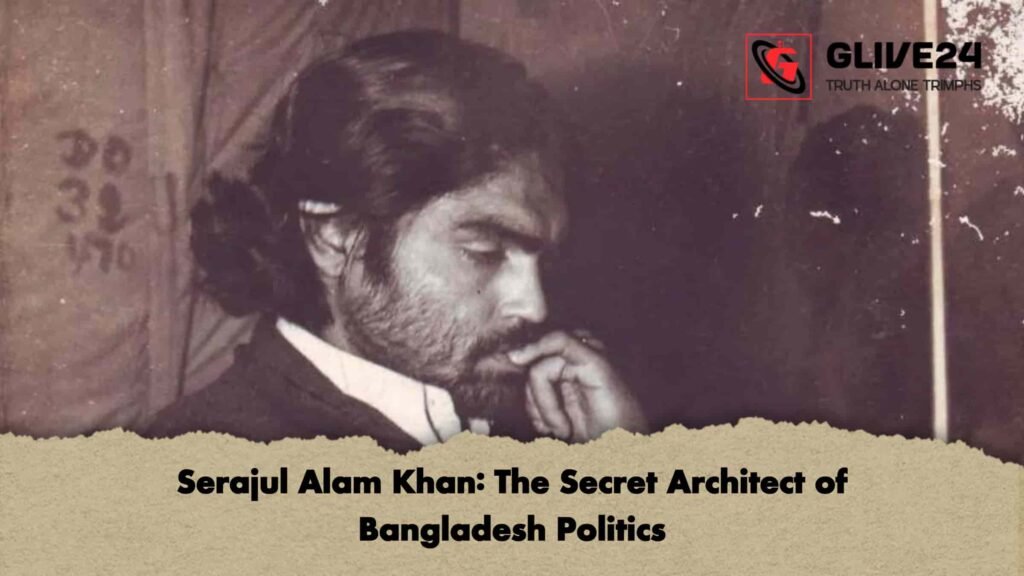
The history of the Bangladeshi independence movement, the evolution of its nationalist philosophy, and the structural foundations of the post-liberation state are deeply tied to the strategist Serajul Alam Khan. Known affectionately to his peers and followers as “Dadabhai,” Khan was an author, a political theorist, and a key clandestine designer of the nation’s independence strategy.
Early Background and Ideological Foundations
Serajul Alam Khan was born on 6 January 1941 into a middle-class family in the Begumganj upazila of Noakhali district. His father, Khorshed Alam Khan, was an Edinburgh-educated government officer who retired as the Deputy Director of Public Instruction, whilst his mother, Syeda Zakia Khatun, came from a traditional Pir family. Khan completed his matriculation at Khulna Zilla School in 1956 and completed his intermediate studies at Dhaka College between 1956 and 1958. He subsequently read mathematics at the University of Dhaka from 1958 to 1962, a period where he became deeply involved in anti-colonial student activism.
During the height of the 1960s mass political movements under the military administration of Ayub Khan, Serajul Alam Khan concluded that traditional constitutional bargaining would never secure self-determination for the Bengali population. He maintained that true emancipation required the complete dismantling of the existing state structure and the establishment of a sovereign nation-state.
The Nucleus and Revolutionary Frameworks
To translate this vision into an organized movement, Khan, along with fellow student leaders Kazi Aref Ahmed and Abdur Razzaq, established a secret underground vanguard in 1962 known simply as the Nucleus (later designated as the Swadhin Bangla Biplobi Parishad). Historians identify this underground network as the primary intellectual engine that systematically organized and advanced the idea of independent statehood years before it entered mainstream public discourse.
The Nucleus took charge of developing the foundational symbols and identity of the future republic:
-
The Flag: The cell conceptualized and created the initial flag of independent Bangladesh, which featured a gold map of the territory inside a red circle.
-
The Anthem: They chose Rabindranath Tagore’s Amar Sonar Bangla to serve as the future national anthem.
-
The Slogan: They formulated and popularized the historic rallying cry Joy Bangla.
-
The Title: The group originally proposed and conferred the honorific title “Bangabandhu” upon Sheikh Mujibur Rahman.
Strategic War Leadership and Behind-the-Scenes Influence
Khan served as the General Secretary of the East Pakistan Chhatra League from 1963 to 1965, using his position to mobilize student bodies during the 1966 Six-Point Movement and the 1969 Eleven-Points Programme. He was central to forming the armed wings of the underground apparatus, namely the Bangladesh Liberation Force (BLF) and the Joy Bangla Bahini. During the nine-month Liberation War in 1971, this force operated under the name Mujib Bahini, commanded jointly by Khan, Sheikh Fazlul Huq Moni, Abdur Razzaq, and Tofail Ahmed.
Despite his immense institutional influence, Khan consistently refused public office, parliamentary seats, or ministerial portfolios. He preferred to direct high-stakes political maneuvers entirely from behind the scenes, a trait that earned him the permanent moniker “Politics’ Mystery Man” (Rajnitir Rahasyapurush). His theoretical input was also utilized in structuring the revolutionary concepts behind Sheikh Mujibur Rahman’s historic 7th March speech in 1971.
Post-War Dissidence, Incarceration, and Academic Pursuits
Following independence, Khan’s political path diverged from the newly formed administration. Advocating for a framework of “scientific socialism” tailored to agrarian realities, he broke away from the ruling Awami League to act as the chief theoretician and mentor behind the formation of the Jatiyo Samajtantrik Dal (JSD) in 1972. His strategic oversight was also closely connected by historians to the tumultuous Sipah-Janata uprising on 7 November 1975.
This active political defiance led to consecutive crackdowns by successive regimes. Khan was arrested on three separate occasions and spent a combined total of nearly seven years in prison between 1976 and 1981. He used his time in confinement and subsequent periods in hiding to study global history, political philosophy, and decentralized governance. In 1996, he temporarily moved to the United States to serve as a visiting professor of political science at the University of Wisconsin-Oshkosh, where he taught alternative socio-economic and administrative frameworks.
Chronicle of Key Historical and Institutional Milestones
| Year | Historical Milestones and Institutional Actions |
| 1941 | Born on 6 January in Noakhali District, British India. |
| 1962 | Co-founded the secret underground political organization known as the Nucleus. |
| 1963 | Appointed General Secretary of the East Pakistan Chhatra League (serving until 1965). |
| 1971 | Co-commanded the Mujib Bahini during the nine-month Liberation War. |
| 1972 | Provided the ideological framework for the breakaway Jatiyo Samajtantrik Dal (JSD). |
| 1976 | Arrested by military authorities; held in prison until his release in May 1981. |
| 1996 | Served as a Visiting Professor of Political Science at the University of Wisconsin-Oshkosh. |
| 2023 | Passed away on 9 June at Dhaka Medical College Hospital at the age of 82. |
Khan spent his final decades completely retired from public life and active political alignments, remaining accessible only to researchers, authors, and close political analysts. On 9 June 2023, he suffered respiratory failure and passed away at Dhaka Medical College Hospital at the age of 82. He was buried with full state honors in his ancestral family graveyard at Alipur village in Begumganj, wrapped in his mother’s saree in accordance with his explicit final instructions. His written essays, political theories, and unconventional strategic frameworks remain major subjects of study for historians investigating the geopolitical birth of Bangladesh.