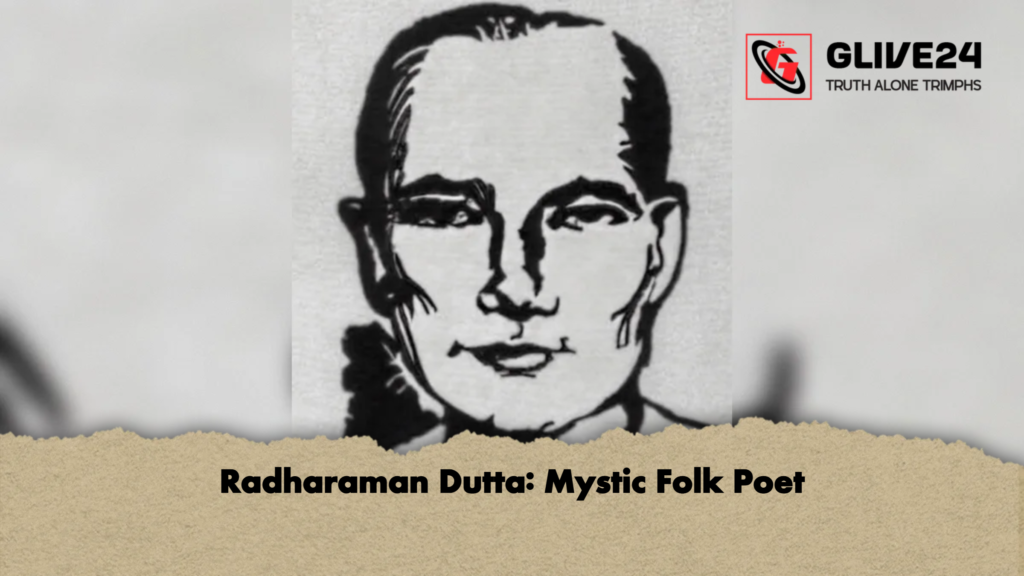
Radharaman Dutta remains one of the most luminous figures in the history of Bengali folk music and Vaishnav devotional literature. Widely regarded as the pioneer of Dhamaal songs, he was not merely a composer but a spiritual visionary whose work fused devotion, love, and mysticism into a distinctive cultural tradition that continues to shape the musical heritage of Bengal.
Born on 25 May 1833 in the village of Keshabpur in the Atuwajan pargana of Jagannathpur, now in Sunamganj district, Radharaman Dutta hailed from a respected and culturally inclined family. His father, Radhamadhab Dutta, and mother, Surbana Devi, fostered an environment steeped in learning, spirituality, and artistic appreciation. From an early age, he was exposed to music, literature, and religious thought, which profoundly shaped his intellectual and spiritual development.
During his adolescence, he became deeply engaged in the exploration of spiritual truth and the nature of the divine. Seeking meaning beyond worldly existence, he travelled widely and associated with various saints and mystics, absorbing their teachings. He later became a disciple of the saint Raghunath Goswami of Dheupasha village in Moulvibazar. Through rigorous study of Shakta, Vaishnava, and Shaiva philosophies, he eventually embraced the path of Sahajiya mysticism, which emphasises simplicity and direct spiritual experience.
He established a secluded hermitage in the tranquil environment of the Nalua Haor wetlands, where he devoted himself entirely to spiritual practice and musical composition. Immersed in devotion to Lord Krishna, he created hundreds of devotional songs, verses, and folk compositions. His creative process was intensely spontaneous; he would sing in states of deep emotional absorption while disciples recorded his compositions, leaving behind no handwritten manuscripts.
Key Life Events
| Year | Event |
|---|---|
| 1833 | Born in Keshabpur, Sunamganj |
| Early life | Spiritual training within family environment |
| Youth | Spiritual travels and association with saints |
| Mid-life | Disciple of Raghunath Goswami |
| Later years | Intensive devotional composition in Nalua Haor |
| 1915 | Passed away on 10 November |
Radharaman Dutta’s compositions reflect a rare synthesis of Vaishnav devotion and Sufi-influenced humanism. His songs express multiple dimensions of love—earthly and divine—ranging from the pain of separation between Radha and Krishna to the deeper longing of the human soul for union with the infinite.
The Dhamaal tradition he pioneered remains integral to rural Bengali cultural life. Even today, his songs are performed at weddings and festive gatherings across Bengal, both in Bangladesh and India. His works continue to resonate through radio, television, and contemporary musical reinterpretations, introducing new generations to his spiritual and artistic legacy.
Personal tragedy marked his later life. The loss of his wife and two sons led him towards deeper renunciation and intensified spiritual devotion. His eldest son, Bipin Bihari Dutta, later settled in Bhujbal village in Moulvibazar, and his descendants still reside there, preserving his memory.
Radharaman Dutta was laid to rest in his birthplace, Keshabpur. His tomb remains a revered site visited by devotees, researchers, and cultural enthusiasts. Over the years, dedicated caretakers have preserved the site with devotion, ensuring that his legacy remains alive.
Though he passed away on 10 November 1915, his poetic voice continues to echo through Bengali cultural consciousness. His immortal lyric—evoking the burning anguish of separation from Krishna—stands as testimony to his enduring significance as a chronicler of the human heart and its longing for the divine.