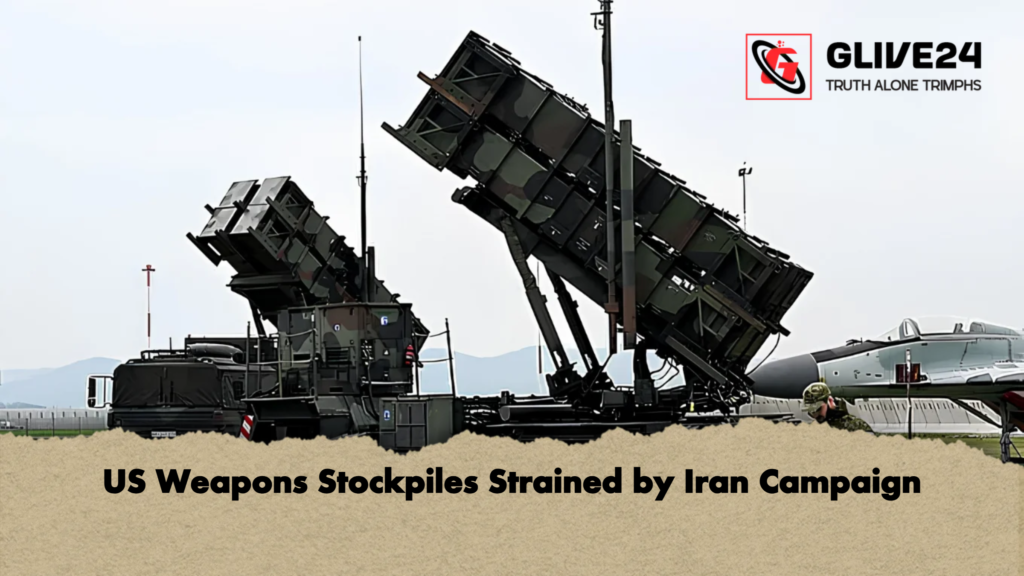
The United States’ stockpile of key precision-guided weapons has fallen sharply, raising concerns that maintaining the current pace of military operations against Iran could place even greater strain on America’s arsenal and affect its readiness for future conflicts.
The warning comes as President Donald Trump declared that the ceasefire with Iran is now “over”, fuelling expectations that military operations could continue. Defence analysts say an extended campaign would require sustained use of sophisticated missiles that are costly to manufacture and cannot be replaced quickly.
Experts caution that the depletion of advanced weapons could weaken the US military’s ability to respond effectively to potential future confrontations with major adversaries such as China or North Korea. Those concerns have been echoed by several defence specialists who argue that maintaining sufficient reserves is essential for preserving strategic deterrence in multiple regions.
Mark Cancian, a defence analyst at the Centre for Strategic and International Studies (CSIS) and a retired US Marine Corps colonel, said that if the conflict continued at the same operational tempo seen over the previous five days, American missile inventories would fall to levels that could create significant security risks in the Indo-Pacific region.
According to defence analysts, the opening phase of the Iran conflict required the United States to fire thousands of advanced missiles for long-range precision strikes while also intercepting incoming ballistic missiles and aerial threats. Such weapons are among the most sophisticated in the US arsenal and are produced in relatively limited numbers.
Michael O’Hanlon, Director of Foreign Policy Research at the Brookings Institution, said there was little doubt that US missile inventories had dropped well below the levels many defence planners would ideally like to maintain.
CSIS estimates suggest that by the time full-scale fighting between the United States and Iran subsided in April, the Pentagon had expended at least half of its Terminal High Altitude Area Defence (THAAD) interceptor missiles, nearly half of its Patriot air defence missiles and about 30 per cent of its Tomahawk land-attack cruise missiles. Three people familiar with the Pentagon’s internal inventory assessments reportedly confirmed those estimates.
Cancian noted that rebuilding these stockpiles will not be a rapid process. Under the current procurement schedule for the fiscal year, the Pentagon is expected to receive only around 15 new Tomahawk missiles and approximately 20 Patriot missiles each month. No deliveries of new THAAD interceptors are currently forecast for 2026, highlighting the gap between wartime consumption and peacetime production.
CSIS estimates that restoring inventories to their pre-conflict levels could take at least three years, assuming current production rates remain unchanged.
John Ferrari, a defence procurement specialist associated with the American Enterprise Institute, said the US Congress has not approved any additional funding specifically to replenish missile inventories since the conflict began. As a result, replacement efforts continue to rely largely on the normal annual procurement process rather than an accelerated wartime programme.
The White House has recently submitted a formal request to lawmakers for supplemental funding to help cover the costs associated with the Iran conflict. Analysts, however, believe securing congressional approval could prove politically difficult.
A Pentagon official said the Department of Defense remains committed to expanding the country’s defence industrial base. To accelerate missile production and reduce administrative delays, President Trump invoked the Defence Production Act in June. The department has also signed contracts with manufacturers aimed at expanding production capacity and strengthening supply chains.
The official added that the Pentagon is working to harness advanced American technologies to increase large-scale manufacturing and improve industrial resilience. Cancian, however, argued that while the Defence Production Act is a useful tool, its overall impact will be limited in the short term because expanding production facilities and increasing manufacturing output inevitably requires time.
Analysts say the implications extend well beyond the Middle East. Any future conflict involving China would likely require extensive use of precision-guided weapons across the Indo-Pacific, while a military confrontation with North Korea could demand thousands of missiles to strike strategic targets and simultaneously defend US forces and Seoul from large-scale attacks. Against that backdrop, continued heavy expenditure of advanced missiles in the Iran campaign is increasingly viewed as a significant challenge for long-term US military preparedness.