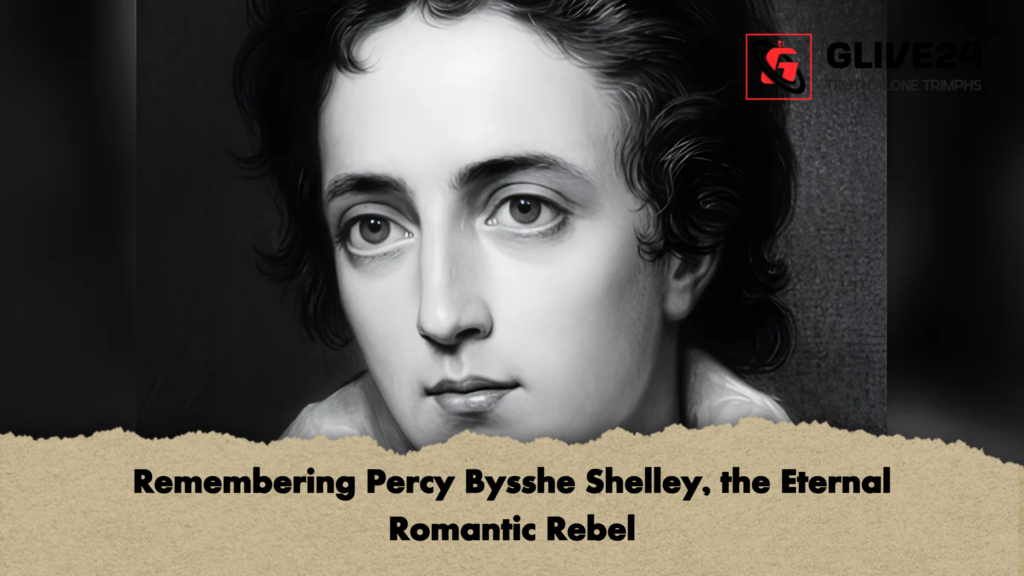
“Our sweetest songs are those that tell of saddest thought.” This hauntingly beautiful observation encapsulates the profound emotional depth of Percy Bysshe Shelley, one of the most brilliant and radical luminaries of English literature. Though his life was tragically cut short, Shelley left an indelible mark on the literary world. His verse seamlessly intertwined themes of human liberation, free thought, love, nature, and political rebellion, securing his place in the upper echelons of the Romantic era.
Born on 4 August 1792 in Sussex, England, Shelley was the eldest son of Sir Timothy Shelley, a wealthy Whig Member of Parliament. After receiving his early education locally, he attended Eton College, where he famously resisted the brutal culture of bullying, earning the moniker “Mad Shelley” for his eccentric and fiercely independent nature. He subsequently matriculated at University College, Oxford, a place that would soon become the backdrop for his first major rebellion against authority.
At the tender age of nineteen, Shelley co-authored and published a provocative pamphlet entitled The Necessity of Atheism. The tract boldly argued that religious belief should be subjected to the rigorous scrutiny of reason and free inquiry rather than blind faith. When summoned by university officials, his refusal to disavow his radical views led to his immediate expulsion in 1811. This pivotal event alienated him from his conservative father and set the tone for a lifelong, uncompromising stance against institutional tyranny.
Shelley, along with John Keats and Lord Byron, formed the core of the second generation of British Romantic poets. Unlike the older generation of William Wordsworth and Samuel Taylor Coleridge, these younger contemporaries infused their poetry with intense political idealism, sensuous imagery, and a restless desire for societal transformation. Shelley’s masterworks, including Ozymandias, Ode to the West Wind, To a Skylark, The Cloud, The Mask of Anarchy, and the lyrical drama Prometheus Unbound, demonstrate an extraordinary command of lyrical rhythm, linguistic elegance, and visionary passion.
His creative output extended beyond poetry. Early in his career, he authored two Gothic novels, Zastrozzi and St. Irvyne. His intellectual world was further enriched by his marriage to Mary Wollstonecraft Godwin, who achieved immortality as Mary Shelley, the author of the seminal novel Frankenstein. The couple lived an unconventional, nomadic existence, eventually settling in Italy alongside a vibrant circle of expatriate writers.
During his lifetime, widespread critical acclaim eluded Shelley. His progressive ideas, staunch pacifism, and controversial stances on religion and politics made him an outcast in contemporary British society, where his work was frequently censored or misunderstood. Posthumously, however, his literary legacy underwent a dramatic reappraisal. He came to be recognised as a prophetic voice for social justice, profoundly influencing subsequent generations of poets, political thinkers, and reformers.
Tragedy struck on 8 July 1822. Whilst returning from Livorno to Lerici on his small, custom-built schooner, the Don Juan, the 29-year-old poet was caught in a sudden, violent storm in the Gulf of Spezia. The vessel foundered, and Shelley’s body washed ashore days later. Whilst rumours of foul play and speculation about suicide circulated at the time, historians broadly agree that the sinking was a tragic maritime accident.
Despite his brief thirty years on earth, Percy Bysshe Shelley remains an enduring icon of creative defiance. The timeless closing line of Ode to the West Wind—”If Winter comes, can Spring be far behind?”—continues to serve as a universal anthem of optimism. It reminds readers across the centuries that even in the darkest hours of human despair, the promise of renewal and liberty is never far away.