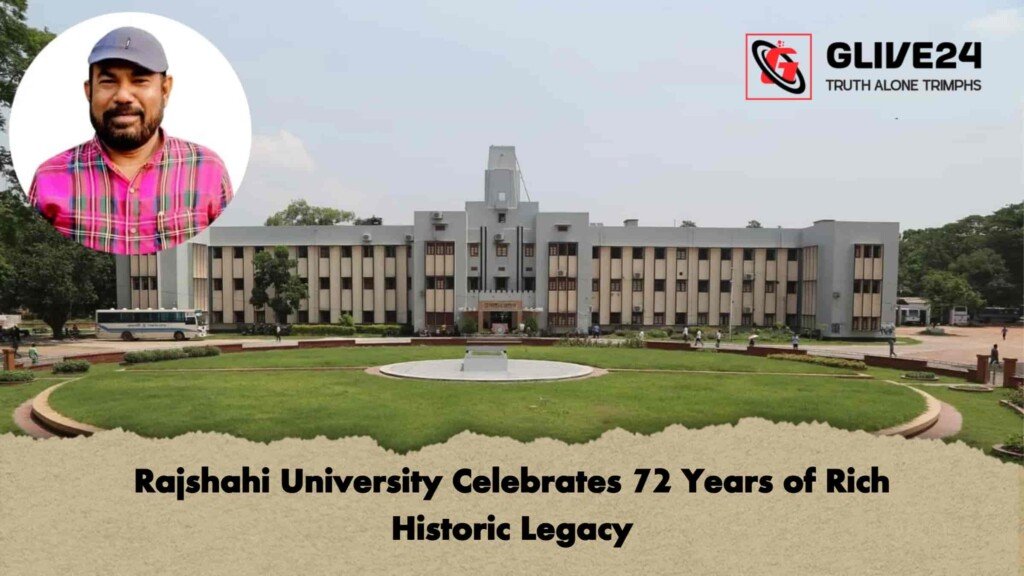
Rajshahi University, the premier seat of higher education in northern Bangladesh, has officially completed 72 years of its journey, entering its 73rd year of academic excellence, democratic struggle, and cultural heritage. The milestone has triggered widespread celebrations and deep nostalgia among its vast community of current students, faculty, and distinguished alumni across the globe.
For generations of students, the institution—affectionately known as the “Motihar Green Campus”—represents far more than an academic centre. It is widely regarded as a crucible for leadership, intellectual awakening, and political consciousness. Alumni, including prominent journalists and student leaders like ABM Zakirul Haque Titon, a former magazine editor of the Rajshahi University Central Students’ Union (RAKSU), have noted that the values of democratic resistance and intellectual liberty instilled by the university remain central to their personal and professional identities.
Table of Contents
A History Forged Through Mass Movement
The establishment of Rajshahi University was the culmination of a protracted and intense public demand for higher education in the neglected northern region of Bengal. Although the historic Rajshahi College had introduced postgraduate and law courses as early as 1873, these programmes were later discontinued. Following the partition of British India in 1947, the lack of educational facilities for the youth of North Bengal became an urgent socio-political issue.
On 15 November 1950, a 64-member struggle committee comprising local educationists, politicians, and civil society leaders was formed to spearhead the demand for a full-fledged university. The movement gained unstoppable momentum during the language movement of 1952. Following student protests at Rajshahi College on 6 February 1952, and subsequent mass rallies on 10 and 13 February, the demand transformed into a popular uprising.
Despite the imprisonment of 15 prominent student leaders by the then-authorities, the government was ultimately forced to capitulate to public pressure. The Rajshahi University Act was passed on 31 March 1953, and the institution formally commenced its administrative journey on 6 July 1953, with the distinguished scholar Professor Itrat Husain Zuberi serving as its first Vice-Chancellor.
Evolution of the Motihar Campus
In its nascent years, the university operated out of temporary premises at Rajshahi College and various historic structures across the city, including Bara Kuthi, Lal Kuthi, and Fuller Hostel.
The campus later shifted permanently to its present location at Motihar, a beautifully landscaped area near the Padma River. The iconic campus was designed by the renowned Australian architect Dr Swaney Thomas in the mid-1960s. Today, the Motihar campus is celebrated nationwide for its architectural symmetry, lush green canopies, and an environment uniquely conducive to free thought and rigorous scientific research.
A Legacy of Sacrifice and Democratic Resilience
The history of Rajshahi University is inextricably linked with the broader struggle for the rights, democracy, and independence of Bangladesh. It holds a unique and somber distinction in global academic history for the ultimate sacrifices made by its faculty and students.
During the 1969 mass uprising against the Pakistani regime, the university’s Proctor, Dr Mohammad Shamsuzzoha, was brutally shot dead while shielding his students from armed military personnel. Dr Zoha is widely revered as the first university teacher in the country to lay down his life for the democratic rights of students, an event that catalysed the independence movement.
The university paid a heavier price during the 1971 Liberation War. Numerous faculty members, administrative staff, and students were targeted and systematically murdered by occupation forces. Among the immortalised martyrs are Professor Habibur Rahman, Sukhranjan Samaddar, and Mir Abdul Kayyum.
In the post-independence era, the campus remained a bastion of resistance against autocratic regimes. On 22 December 1984, during anti-autocracy demonstrations, student leader Shajahan Siraj and a local vendor named Abdul Aziz were killed, while the former RAKSU Vice-President, Ruhul Kabir Rizvi, sustained severe bullet wounds. The university also stood firm in subsequent decades against communalism and religious extremism, witnessing the martyrdom of students like Yassir Ahmed Pitu and the permanent incapacitation of others.
Looking to the Future
As Rajshahi University steps into its 73rd year, stakeholders emphasise that its glorious past must serve as a compass for its future. Stakeholders, including the administration, faculty, and alumni networks, have renewed their commitment to transforming the institution into a world-class hub for innovation, scientific research, and humanitarian values. The prevailing sentiment across the community emphasizes that the university must actively shield itself from partisan narrowness, corruption, and campus violence to truly remain a beacon of morality, enlightenment, and intellectual freedom.
Author:

ABM Zakirul Haque Titon
Editor and Publisher, Khoborwala, G-Live
Former Newspaper Editor, RAKSU.