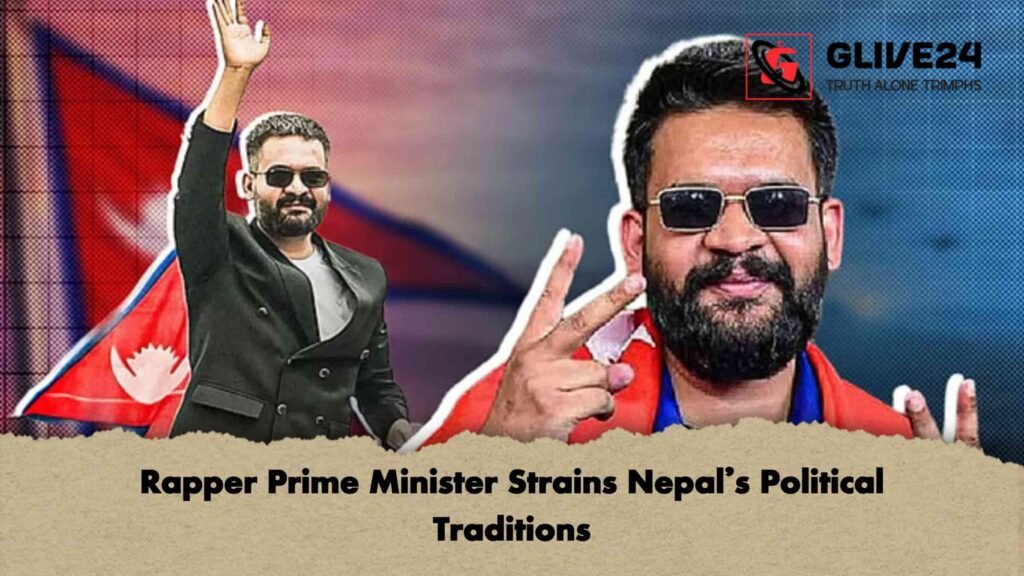
The political landscape of Nepal underwent a significant shift following a Gen-Z-led mass uprising that culminated in the election of Balendra Shah, popularly known as Balen, to the office of Prime Minister. Previously famous as a rapper whose hit song “Ma Nepal Ho, Haseko Herna Chahanchhu” (“I Want to See Nepal Smile”) secured millions of digital views and aided his initial entry into politics during the Kathmandu mayoral race, Shah now leads a government that has passed its first two months in office. However, the initial public optimism is increasingly being replaced by domestic controversy and diplomatic friction.
Executive Absences and Institutional Strain
While newly formed governments are typically granted a “honeymoon period” by the press, Prime Minister Shah has faced sharp accountability metrics from major national media outlets within his first 50 to 60 days. The Kathmandu Post has published at least five critical editorials and commentaries over the last two months, drawing attention to unconventional governance methods that critics argue bypass democratic traditions.
A central point of contention is the 36-year-old Prime Minister’s regular absence from parliament, despite the physical proximity of the executive office to the legislative chamber. In a departure from historical precedent, Shah did not deliver an address to parliament during his initial six to seven weeks in power. On 13 May, national reporting highlighted that his absence detracted from legislative accountability, followed by a 14 May editorial emphasizing the public’s right to executive transparency.
Furthermore, during a joint parliamentary session on 2 April, Shah exited the chamber midway through an address by President Ram Chandra Poudel. The Prime Minister has also declined to engage in parliamentary question-and-answer sessions, delegating these constitutional duties to the Finance Minister. Observers note that these practices align more with a presidential system than Nepal’s established parliamentary structure. This shift towards centralized executive control was further demonstrated by the administration’s decision to reassign the National Investigation Department from the Ministry of Home Affairs directly to the Office of the Prime Minister.
Urban Clearance and Economic Disparities
Domestically, the administration is facing widespread protests over its urban renewal policies, which have utilized bulldozers to demolish informal settlements and slums in Kathmandu and other major urban centres. Human rights groups and organizations representing the impoverished have condemned the evictions as inhumane, pointing to the severe wealth inequality present within the country.
Data published earlier this year by Oxfam highlights the sharp economic stratification within Nepal:
| Population Category | Proportion of National Wealth |
| Top 1% | Approximately 25% |
| Bottom 50% | Less than 5% |
The destruction of shelters prior to the implementation of resettlement schemes has led to daily demonstrations across multiple cities. While the government has stated its intention to introduce rehabilitation measures for displaced residents, the immediate lack of housing has fueled public dissatisfaction.
Judicial Disagreements and Policy Reversals
The appointment of Manoj Kumar Sharma as Chief Justice has triggered a significant legal and constitutional dispute. Prime Minister Shah bypassed three senior judges to elevate Sharma to the position. The government maintains that the appointment followed a formal recommendation by the Constitutional Council and secured the necessary two-thirds parliamentary approval. However, because the Prime Minister heads the Constitutional Council and his coalition commands a two-thirds majority in parliament, the decision has been legally challenged in the Supreme Court. The appointment has created internal divisions within the judiciary, particularly since three active Supreme Court justices hold seniority over the new Chief Justice.
Simultaneously, the judiciary has intervened to stay several high-profile executive decrees issued by the Shah administration:
-
Civil and Student Rights: On its first day, the government issued a ban on student political activity and civil service trade unions. The High Court subsequently stayed the directive, ruling that the right to form unions is fully protected under the Civil Service Act of 1992 and conforms to International Labour Organization (ILO) conventions. International labour organizations also submitted formal objections to the Prime Minister’s office regarding the ban.
-
Border Management and Tariffs: The judiciary stayed a new border regulation that imposed tariffs ranging from 5% to 80% on all daily consumer goods valued over 100 Nepalese Rupees entering from India. This policy significantly impacted the Madhesh region, where local populations rely on historical, open-border access to Indian markets for essential goods, medicines, and household provisions.
Diplomatic Realignments and Internal Party Friction
The ruling Rastriya Swatantra Party (RSP), established in 2022 by young professionals, integrated Shah into its ranks under a seven-point agreement shortly before the 5 March elections. Amidst mounting public criticism, internal party anxiety has risen. RSP officials report that the Prime Minister rarely attends party meetings and maintains minimal contact with party leaders, limiting the organization’s influence over state policy.
In foreign affairs, the RSP’s pre-election platform pledged to transition Nepal from a geopolitical “buffer state” into a “connector state” between India and China. However, since the government was established on 27 March, diplomatic activity has shifted noticeably towards the United States. US Assistant Secretary of State Paul Kapoor visited Nepal following a trip to Bangladesh, focusing primarily on the welfare of Tibetan refugees.
This focus has caused concern in Beijing, which opposes external political activity regarding Tibet. During the Gen-Z protests, certain demonstrators were observed wearing “TOB” (The Original Blood) t-shirts—a group believed to be linked with pro-Tibetan independence monks. Chinese authorities suspect a faction within the current administration is encouraging anti-China sentiment.
Concurrently, relations with New Delhi have experienced friction. A planned official visit to Kathmandu by Indian Foreign Secretary Vikram Misri was recently cancelled. Media reports indicate the cancellation occurred because Prime Minister Shah adopted a policy of declining formal bilateral meetings with foreign officials who do not hold an equivalent head-of-government rank.
This diplomatic stance has surprised Nepal’s civic leadership. As a landlocked country historically described by its founder, Prithvi Narayan Shah, as “a yam between two boulders,” Nepal relies on balanced diplomacy with both neighbouring powers. Tensions remain elevated regarding the disputed Lipulekh territory, where India and China plan to initiate bilateral trade this June, an arrangement that has generated a sense of exclusion within Kathmandu. Although analysts question the efficacy of avoiding direct diplomatic dialogue, current plans indicate Shah will undertake his first official overseas visit to India to address these boundary issues.
Visual Symbolism and Evolving Political Culture
In addition to policy disputes, Prime Minister Shah remains a subject of public debate regarding his personal attire and presentation. He frequently departs from traditional Nepalese official dress, opting instead for designer clothing, sportswear, and black sunglasses during parliamentary appearances—images that regularly circulate widely online.
On 16 May, Shah departed from his customary black clothing, posting a photograph of himself in white attire on Facebook, which immediately drew widespread social media engagement. While some commentators view these aesthetic adjustments as symbolic indicators of a transition toward a more moderate governance style, the focus on non-traditional presentation reflects a broader evolution in regional political culture, where digital popularity and generational identity increasingly substitute for conventional administrative experience.