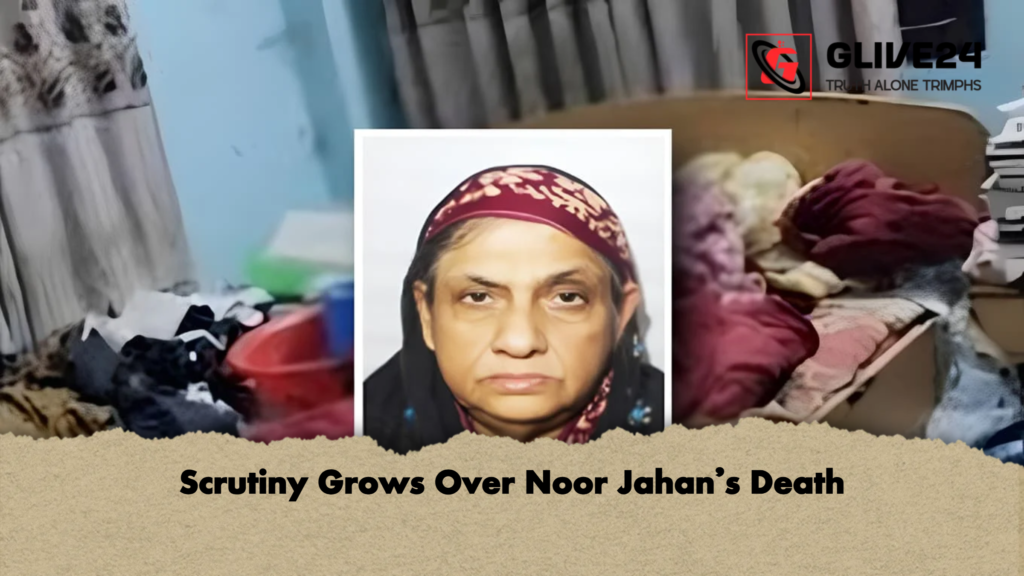
The death of 75-year-old Noor Jahan Begum, whose body was recovered from a flat in Mirpur, has sparked widespread public discussion and scrutiny across Bangladesh. Allegations initially circulated that she had died after suffering severe neglect by her highly educated children and that her body had remained undiscovered for several days.
Following the incident, a Supreme Court lawyer served a legal notice on Noor Jahan Begum’s children on 3 June. Separately, her son, A K M Anisur Rahman, a member of the Mongla Port Authority, was withdrawn from his position and attached to the Ministry of Public Administration.
Noor Jahan Begum’s body was recovered on 31 May from a fourth-floor flat located on Road No. 13, Block C, Section 6 of Mirpur. Videos shared on social media showed the flat in an untidy and unhygienic condition. Observers also pointed to a white fungal-like substance visible on her right eye, while some individuals present at the scene claimed to have seen insects on the body.
Based on statements from local residents, several media reports suggested that Noor Jahan Begum had died at least a week before her body was recovered. According to those reports, a nurse was informed only after a foul smell emerged from the flat, and the police were subsequently notified.
However, an investigation conducted by glive24 reportedly found no evidence supporting those allegations. Individuals associated with the post-mortem examination stated that Noor Jahan Begum had died at some point within the 24 hours preceding the arrival of her body at the morgue.
Medical sources involved in the examination also indicated that claims of advanced decomposition caused by a prolonged period after death were not supported by the findings. The wound visible on her back was identified as a bedsore, medically known as a pressure ulcer. Such injuries are commonly seen among elderly individuals who remain in the same sitting or lying position for extended periods. The condition can produce blisters, wounds and tissue damage that may resemble decomposition.
Key Findings and Reported Information
| Issue | Information Reported |
|---|---|
| Date body recovered | 31 May |
| Location | Fourth-floor flat, Mirpur Section 6, Block C, Road 13 |
| Age of deceased | 75 years |
| Post-mortem indication | Death occurred within 24 hours before arrival at the morgue |
| Back injury | Identified as a bedsore (pressure ulcer) |
| Legal action | Legal notice sent to children on 3 June |
| Burial | Conducted the day after recovery in the family village home in Chandpur |
According to the investigation, while several factors contributed to the unclean condition of the residence, no evidence was found to substantiate allegations that Noor Jahan Begum had been abandoned by her children or denied financial support.
The flat from which her body was recovered belonged to her daughter. Family members stated that she had lived with her daughter for the final two years of her life. Before that, she had spent periods living with each of her two sons. They further claimed that on Eid, two days before her death, her younger son visited the flat and shared sacrificial meat with his mother.
Family members maintain that Noor Jahan Begum died on 31 May, the same day her body was recovered by police and sent to the Shaheed Suhrawardy Hospital morgue for post-mortem examination. The following day, she was buried at the family’s ancestral home in North Chandpur Upazila. Her eldest son, Joint Secretary A K M Anisur Rahman, was present and supervised the burial arrangements.
In an effort to clarify the controversy surrounding the case, glive24 conducted a two-day investigation. The report identified Noor Jahan Begum’s eldest son as Joint Secretary A K M Anisur Rahman, her younger son as Dr A K M Ashikur Rahman, a professor in the Department of Computer Science and Engineering at Bangladesh University of Engineering and Technology (BUET), and her daughter Fatima Nasrin Sultana as a school teacher in Mirpur.
The findings cited in the investigation indicate that claims regarding prolonged neglect, abandonment, and the body remaining undiscovered for an extended period were not supported by the evidence referenced in the report.