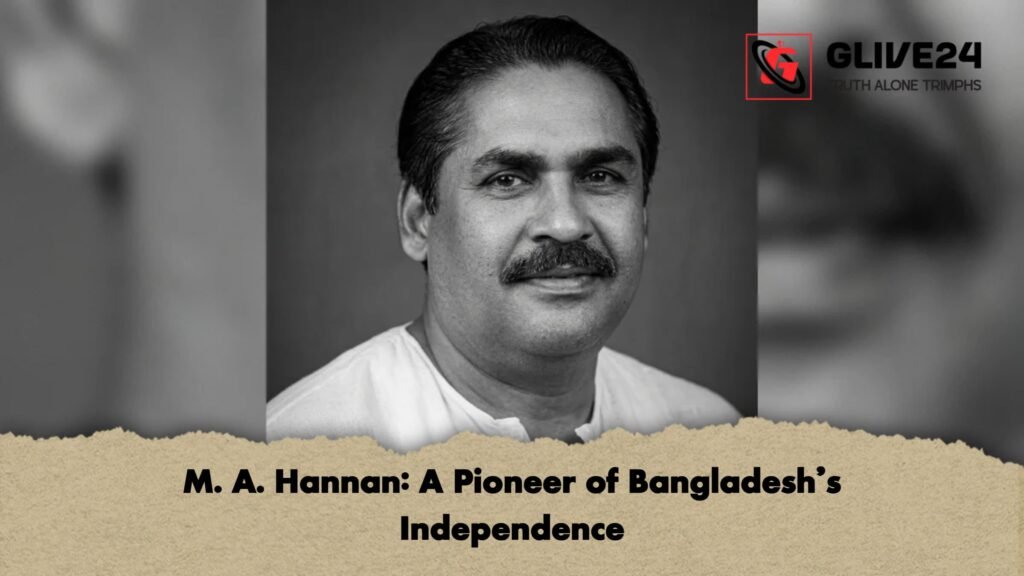
The history of Bangladesh’s struggle for self-determination and sovereign independence features prominent figures whose contributions remain foundational to the nation. Amongst them, M. A. Hannan stands out as a courageous patriot, a dedicated labour leader, and a pivotal organiser during the 1971 Liberation War. He is historically recognised for delivering one of the earliest broadcasts of the declaration of independence on behalf of Bangabandhu Sheikh Mujibur Rahman.
Early Life and Political Awakening
M. A. Hannan was born on 10 February 1930 in Khaspur village, located within the Tehatta sub-district of the Nadia district in West Bengal. Raised in a politically conscious household, he developed a keen sense of social responsibility from his youth. Following the partition of the Indian subcontinent, his family relocated to Meherpur. During his student years, he became deeply aligned with nationalist sentiments, actively participating in the historic Language Movement of 1952.
Professional Career and Labour Activism
Although M. A. Hannan maintained a professional career as a banking official and a manager at an insurance firm, his primary commitment lay in political activism and grassroots organising. He became a prominent advocate for the rights of the working class, establishing long-standing affiliations with:
-
The Bangladesh Jatiya Sramik League
-
The Bangladesh Railway Sramik League
-
Various labour movements based in the port city of Chittagong
Key Contributions to the Nationalist Movement
As a trusted ally of Bangabandhu Sheikh Mujibur Rahman, M. A. Hannan held key leadership responsibilities within the Chittagong District Awami League. He was an active participant in every major milestone of the Bengali nationalist movement, including:
-
The Six-Point Movement (1966): Campaigning for regional autonomy.
-
The Anti-Agartala Conspiracy Case Agitation (1968): Demanding the unconditional release of Sheikh Mujibur Rahman.
-
The 1969 Mass Upsurge: Mobilising public resistance against institutional discrimination.
By March 1971, civil unrest had reached its peak across East Pakistan. On 24 March 1971, M. A. Hannan served as a principal organiser of the civilian blockade at the Chittagong Port against the MV Swat, a vessel laden with arms and ammunition intended for the Pakistani military.
Following the military crackdown on the night of 25 March, the critical task of disseminating Bangabandhu’s declaration of independence devolved upon him. On 26 March 1971, M. A. Hannan transmitted the declaration of independence from the Kalurghat Radio Station in Chittagong, an event that served to galvanise public resistance and catalyse the formal armed struggle.
Wartime Activities and Post-Independence Legacy
During the nine-month conflict, M. A. Hannan relocated to Agartala, India, where he worked systematically to coordinate freedom fighters. He played a instrumental role in establishing the Harina Youth Camp to train and house recruits. Following the liberation of Bangladesh, he dedicated himself to national reconstruction.
His life was prematurely cut short on 11 June 1974, when he sustained severe injuries in a tragic road accident at Chauddagram. He succumbed to his injuries the following day, 12 June 1974, at Feni Hospital at the age of 44. In recognition of his lifetime of service, the Government of Bangladesh posthumously conferred the Independence Award (Swadhinata Padak)—the nation’s highest civilian honour—upon him in 2013.
Historical Timeline of M. A. Hannan
| Date / Period | Historical Event / Milestone |
| 10 February 1930 | Born in Khaspur, Nadia District, West Bengal. |
| 1952 | Actively participated in the Bengali Language Movement. |
| 1966–1969 | Organised campaigns for the Six-Point Movement and the 1969 Mass Upsurge. |
| 24 March 1971 | Led the public resistance against the weapons carrier MV Swat at Chittagong Port. |
| 26 March 1971 | Broadcasted the declaration of independence from Kalurghat Radio Station. |
| 1971 (Wartime) | Coordinated resistance efforts from Agartala and co-founded the Harina Youth Camp. |
| 12 June 1974 | Passed away at Feni Hospital following a road traffic accident the previous day. |
| 2013 | Posthumously awarded the Independence Award (Swadhinata Padak). |