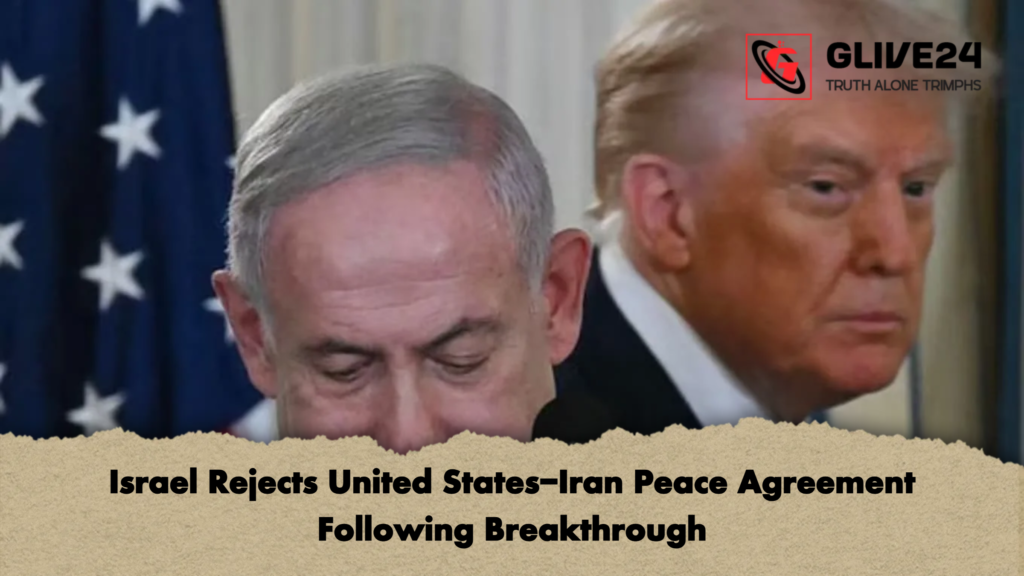
A wave of intense anger and disillusionment has swept across Israel following the late-night announcement on Sunday by Pakistani Prime Minister Shehbaz Sharif that a peace agreement has been brokered between the United States and the Islamic Republic of Iran. The bilateral accord aims to permanently halt military operations across all active fronts, including Lebanon.
Prime Minister Sharif disclosed the development via his account on X (formerly Twitter), extending gratitude to Turkey, Qatar, and Saudi Arabia for facilitating the diplomatic dialogue. The formal signing ceremony is scheduled to take place this coming Friday in Switzerland. Following the announcement, both Washington and Tehran verified the agreement. US President Donald Trump stated that the accord was “complete”, whilst Iranian Deputy Foreign Minister Kazem Gharibabadi indicated that a final definitive framework would be executed within the next 60 days.
The agreement follows a period of mediation by Pakistan, initiated after a joint US-Israeli military campaign was launched against Iran in February. Despite the diplomatic breakthrough, senior Israeli officials have categorically rejected the terms, asserting that the state is not bound by the stipulations. Coinciding with these declarations, Israeli forces launched a series of continuous military strikes across southern Lebanon on Monday.
Cabinet Ministers Vow Non-Compliance
Although Prime Minister Benjamin Netanyahu has yet to issue a public address regarding the deal, Israeli media outlet Ynet reported that he has privately informed President Trump that Israel will not adhere to the agreement, specifically refusing to accept any Iranian-imposed conditions regarding Lebanon.
This stance was echoed by Defence Minister Israel Katz, who affirmed that the Israel Defense Forces (IDF) would maintain an indefinite presence in the security zones of Lebanon, Syria, and the Gaza Strip. Katz added that civilians would be evacuated from occupied zones to facilitate the destruction of residential structures, which he characterized as “terrorist infrastructure”.
Far-right members of the governing coalition expressed fierce condemnation of the diplomatic deal:
-
Finance Minister Bezalel Smotrich: Stated on X that the accord was “detrimental to Israel and the entire free world,” arguing that Israel must now pursue its military campaign against Iran independently. Smotrich, who previously called for the complete destruction of buildings in Beirut, insisted the military must retain complete operational freedom in Lebanon.
-
National Security Minister Itamar Ben-Gvir: Declared on social media that the agreement imposes no obligations on Tel Aviv. “Israel is not a vassal state of the United States; we are an independent and sovereign nation,” Ben-Gvir remarked, dismissing the accord as incapable of securing Israel and asserting that the country is no “banana republic”.
-
Culture Minister Miki Zohar: Reiterated to Ynet that the government’s primary focus remains Iran’s potential acquisition of nuclear weaponry. Zohar warned that if national security is compromised, Israel will launch an intense strike that would force the Iranian leadership “not merely to their knees, but to bow their heads.”
Internal Political Backlash and Media Reaction
While incumbent ministers avoided direct, public criticism of President Trump and Prime Minister Netanyahu, right-wing commentators and opposition figures reacted with uncritical hostility. Media figures traditionally aligned with Netanyahu expressed profound betrayal regarding the American administration’s policy shift.
Yinon Magal, a prominent journalist for Israel’s Channel 14 News often viewed as an unofficial spokesperson for the Prime Minister, stated on X that Israel had been abandoned to face the conflicts in Iran and Lebanon alone. Magal labelled President Trump a defeated figure and US Vice-President JD Vance a detestable individual, whilst using highly derogatory terms to describe US Special Envoy Steve Witkoff and Trump’s son-in-law Jared Kushner. Shimon Riklin, a colleague at the same network, asserted that Israel must forcefully remind a “treacherous America” of its sovereign interests.
Concurrently, the Israel Defense and Security Forum (IDSF) issued a formal statement predicting the ultimate collapse of the accord, stating:
“Any agreement with Iran’s ‘terrorist’ government is bound to fail… This is the time to stand tall, prepare for future eventualities, and refuse any compromise regarding the elimination of threats from Lebanon and Iran.”
The development has simultaneously provided political ammunition to Netanyahu’s secular and centrist opponents, who argue the deal represents a total failure of his long-term security strategy.
Yair Golan, leader of the center-left party The Democrats, described Netanyahu as “weak, infirm, isolated, and lacking influence.” Golan pointed out that President Trump had signed an agreement that preserves Iran’s nuclear and ballistic missile architecture whilst returning billions of dollars in frozen assets to Tehran. This outcome, Golan argued, exposes years of flawed policy overseen by the Prime Minister.
Furthermore, former Chief of General Staff and prime ministerial candidate Gadi Eisenkot remarked that the accord failed to address Israel’s fundamental security requirements. Eisenkot characterized the continuous three-year military campaigns following the 7 October disaster as the grim consequence of an ineffective administration. Former Prime Minister Naftali Bennett also censured the incumbent coalition for its inability to reach definitive strategic conclusions, accusing it of dragging the nation into a war of attrition. Bennett pledged to unseat Netanyahu in the upcoming elections, asserting that he possesses a structured operational plan to dismantle the Iranian leadership.
Official Statements and Institutional Responses
| Source / Official | Institutional Affiliation | Formal Position on the US-Iran Peace Agreement |
| Donald Trump | President of the United States | Confirmed the accord as “complete” following an Oval Office decree. |
| Kazem Gharibabadi | Iranian Deputy Foreign Minister | Anticipates execution of a definitive treaty within 60 days. |
| Israel Katz | Israeli Defence Minister | Rejected terms; announced indefinite IDF deployment in Lebanon, Syria, and Gaza. |
| Yair Golan | Leader of The Democrats (Israel) | Condemned the deal for releasing frozen Iranian assets without dismantling missile systems. |
| IDSF | Israeli Security Think-Tank | Labelled the accord a failure and called for absolute non-compromise on threats. |