Khabor Wala Desk
Published: 7th June 2026, 1:00 PM
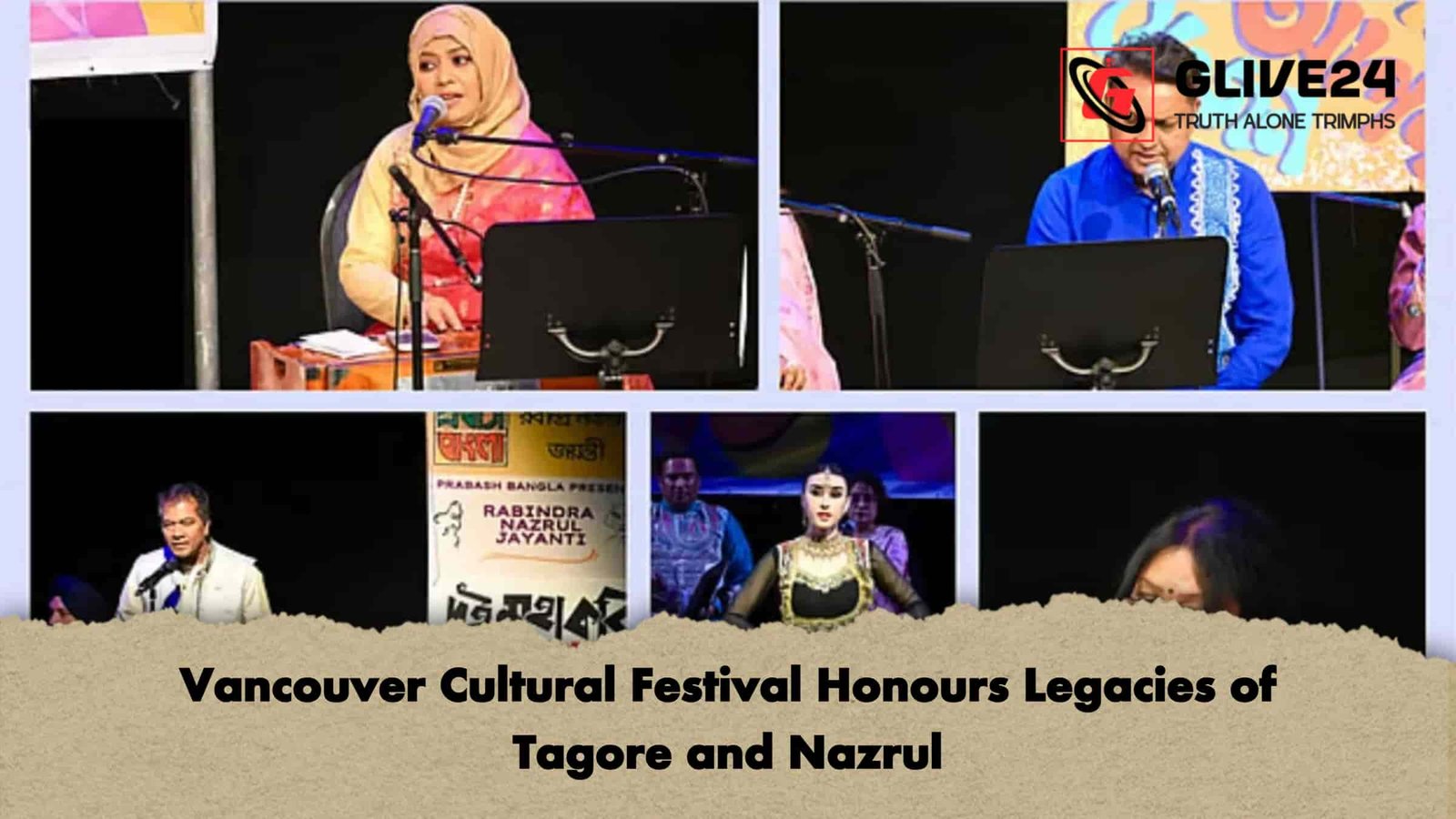
The Vancouver-based “Probash Bangla Cultural Society” has hosted a major cultural assembly to commemorate the birth anniversaries of Asia’s first Nobel laureate, Rabindranath Tagore, and Bangladesh’s National Poet, Kazi Nazrul Islam. Titled “Rabindra-Nazrul Jayanti”, the event commenced at 17:30 on 16 May at the Surrey Arts Centre Studio Theatre in British Columbia, Canada, drawing an extensive audience from the Bangladeshi expatriate community.
Established in 2004, the Probash Bangla Cultural Society operates on strictly secular and non-political principles. The organisation is dedicated to preserving Bengali artistic traditions within North America through the staging of theatrical productions, poetry festivals (Kobipaksho), musical showcases, and Bengali New Year (Pohela Boishakh) festivities.
Table of Contents
The festival was structured around the distinctive artistic modalities of the two poets. Tagore’s compositions were highlighted for their structural reliance on Indian classical ragas and themes of spiritual devotion (Puja), romanticism (Prem), nature (Prokriti), and nationalism (Swadesh). Nazrul’s work was represented through its expressions of secular romanticism, Islamic ghazals, Shyama Sangeet (devotional hymns), folk structures, and revolutionary anti-colonial poetry.
The execution of the 2026 festival was directed by the society’s Board of Directors:
Ananya Sheela Shamsuddin
Lubna Alam
Tania Ghosh
Mikon Das
Sriparna Guhathakurta
Michael Mitra
Shamim Haroon
The evening’s cultural presentations were preceded by an academic discourse delivered by Bipul Kamal, who analysed the underlying philosophies and historical contexts of both literary figures.
The stage was decorated with commemorative banners and portraits of both writers. The performance sequence moved through three distinct artistic phases:
The concert opened with a collective choir rendition of Nazrul’s choral work “Shuvro Somujjwal”, an anthem advocating for social equality and the eradication of injustice. This was followed by a solo vocal performance of Tagore’s devotional prayer “Tomar Kache E Boro Magi” by Sushweta Banerjee.
The youth division of the society then staged a group dance to Nazrul’s rhythmic piece “Shukno Patar Nupur Paye”. This seasonal transition was extended via a duet dance by Oishee and Nabamita, set to the monsoon ragas of “Mon Mor Megher Shonggi” and “Nil Onjon Ghono Kunjo Chhayay”, before concluding with an interpretive routine by adolescent performers Nilav and Mohor to Tagore’s “Alo Amar Alo”.
The mid-section of the festival featured specialized vocal and literary recitals:
Classical and Romantic Solos: Lubna Alam performed Nazrul’s traditional track “Modhur Nupur Baje”, followed by a literary recitation from Shampa. Sudeep Mukherjee and Lalna performed a seasonal vocal duet of “Monjori O Monjori Amer Monjori” and “Aji E Shondha”. Subhojit Das and Mananya Chakraborty presented Tagore’s freedom-themed ballad “Tomar Khola Hawa”.
Devotional Duets and Ballet: Tania Ghosh and Saikat Ghoshal performed Nazrul’s romantic composition “Daraye Duyare”. A classical dance response to “Shyam Sundar Giridhari” was executed by Ira in traditional vestments. Ananya Sheela performed “Sokhi Sajaye De” from Tagore’s lyrical drama Chitrangada, followed by Happy Das’s rendition of the rainy-night monologue “Amar Nishith Rater Badol Dhara”.
Brajabuli Classical and Modern Fusion: Saikat Ghoshal delivered a classical vocal and flute piece based on “Shaon Gogone”, written in the historic Maithili-Brajabuli linguistic blend. Subsequently, Michael Mitra and Tania Ghosh executed an avant-garde musical fusion combining four major Tagore melodies—“Tomar Holo Shuru Amar Holo Sara”, “Mon Mor Megher Shonggi Ure Chole”, “Tumi Kemon Kore Gan Koro He Guni”, and “Jodi Tare Nai Chini Go Se Ki Amay Nebe Chine”—with a contemporary Hindi lyrical arrangement.
The presentation concluded with a combined ensemble performance of Tagore’s universal peace prayer, “Hinsay Unmotto Prithibi”, addressing modern global conflicts. Following the curtain call, Saikat Ghoshal and Michael Mitra presented the official institutional acknowledgements.
The logistics, technical operations, and performance elements of the Surrey Arts Centre production were managed by the following personnel:
| Functional Department | Assigned Personnel / Supporting Entities |
| Compère / Narration | Sriparna Guhathakurta |
| Principal Vocal Ensemble | Sushweta Banerjee, Happy Das, Sudeep Mukherjee, Ananya Sheela, Ranjana Mukherjee, Lubna Alam, Tania Ghosh, Michael Mitra |
| Junior Performance Corps | Subhojit Das, Shuddho Kom Das, Mananya Chakraborty, Mohor |
| Rhythm Section (Tabla & Kahon) | Shuvomoy Dasgupta, Tapas Biswas |
| Instrumentation | Jagjit Sohar (Keyboard), Saikat Das (Guitar) |
| Technical Operations | Ashik Bari (Sound Control & Illumination), Shamim Haroon (Scenography) |
| Facility Management & Logistics | Michelle Mitra (Housekeeping), Tahmidul Bari, Dominic Pranto, William Banerjee (Volunteers) |
| Media & Documentation | Abhishek Karmakar, Derek Baroi (Photography) |
| Patrons & Financial Underwriters | Vishnu Gopal Chatterjee, City of Surrey Cultural Grant, The Like Jaisi / Mahin Sarkar Family, Jahir Uddin, Tariq Malik, Azad Sheikh, Rabin Mahal |
| Institutional Affiliates | Surrey Arts Centre Studio Theatre Staff, Expatriate Bangladesh Community of Vancouver |

Comments